A dependable employee view
Workforce records need a consistent home that remains connected to the daily activities and decisions surrounding each employee.
 Start a project ↗
Product case study · Stafflow HRM Belize
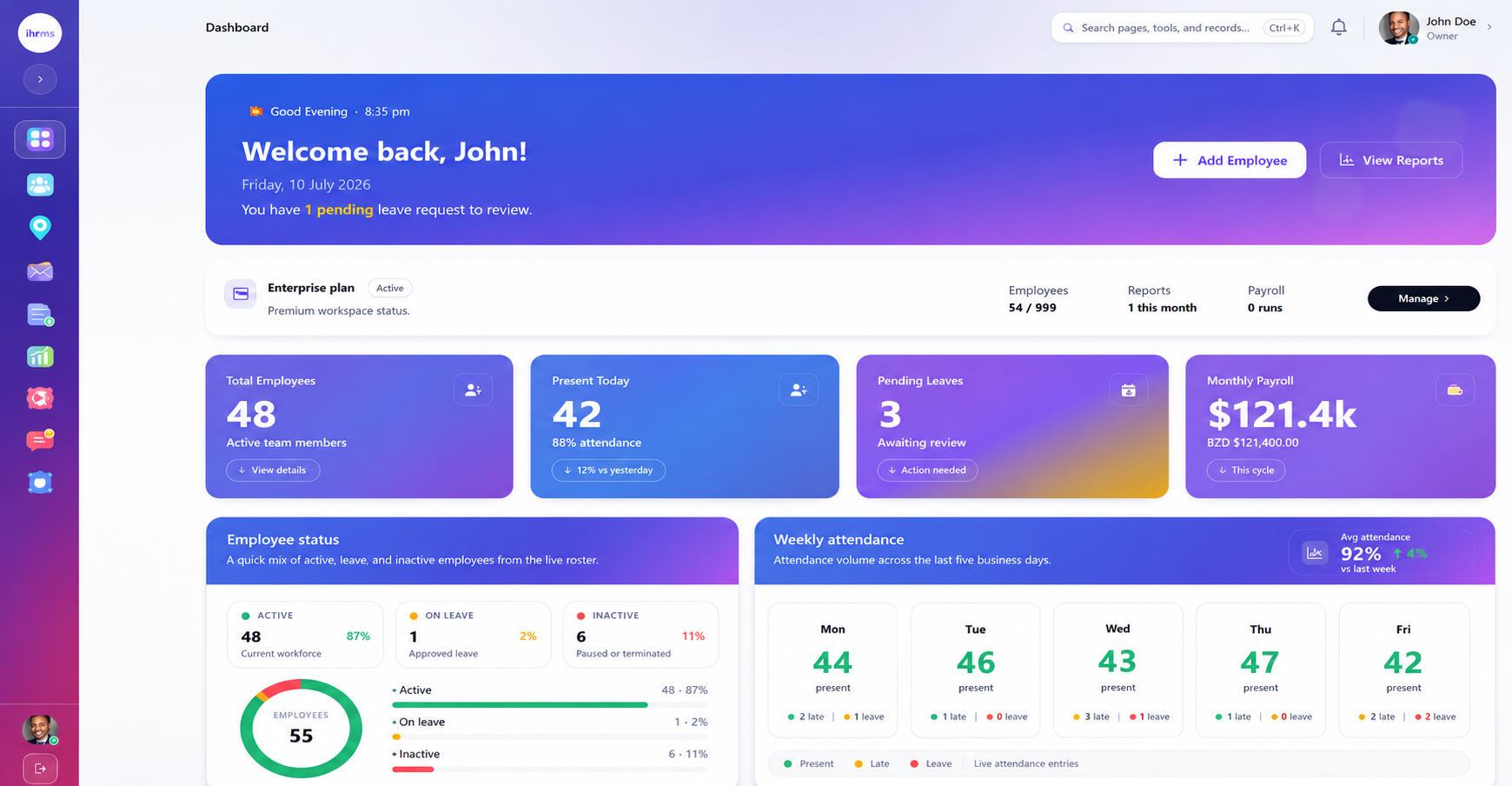
Stafflow is an OptimyzeBZ product that brings employee information, attendance, leave, scheduling and reporting into a shared HR and workforce experience.
Product ownership
This case study describes work OptimyzeBZ can support directly. It does not present Stafflow as a client result, publish adoption figures or claim measured savings.
01 · The business need
Employee records, daily attendance, timecards, leave requests, schedules and reports can become separated across files and tools. That fragmentation makes current activity harder to understand and routine decisions harder to follow.
Workforce records need a consistent home that remains connected to the daily activities and decisions surrounding each employee.
Time activity is more useful when it can be reviewed alongside the people, schedules and reporting connected to it.
Requests, approvals and schedules should remain within a product flow where status and responsibility are visible.
02 · Belize-first direction
The product direction begins with the needs of organisations operating in Belize while keeping the underlying approach useful for continued development.
The challenge was framed as a connected workforce product rather than a set of unrelated screens. Employee management, time activity, leave, scheduling and reporting share an information foundation but still require their own clear workflows.
Stafflow is developed as an evolving product. The public case study describes established product areas without promising every possible HR function or presenting a feature roadmap as already delivered.
Dashboards and reports are designed to bring current activity closer to the manager’s next decision. They remain dependent on accurate records, appropriate access and responsible business policies.
03 · Product areas
Each area supports a different moment while remaining part of one product experience.
A starting point for important totals, current activity and items that may need attention.
Employee records organised within the same environment used for related workforce activity.
Attendance and timecard information connected to the employee and management context around it.
Leave activity kept within the wider workforce workflow so its status remains easier to follow.
A clearer view of schedules alongside the people responsible for carrying out the work.
Connected records presented in ways that support review without inventing certainty the source data cannot provide.
04 · Product and technical delivery
Public technical detail stays intentionally high-level. The case study does not disclose infrastructure secrets, tenant structure, private records or credentials.
Workforce tasks are translated into consistent navigation, readable states and action paths that people can understand across supported devices.
The working product connects interface components to database-backed workflows, validation, authentication and reporting.
Organisation-based architecture helps keep records and actions associated with the appropriate business context. Roles shape what a user can see and do.
Environment configuration and cloud delivery support the working application while keeping production credentials outside the public code and case study.
Permissions, validation, user states and expected failures need deliberate review because workforce data and actions carry real responsibility.
Stafflow remains an ongoing product direction. New work is prioritised through product need and implementation evidence rather than inflated launch claims.
05 · Delivery process
The same four-move method connects business understanding to ongoing product development.
Understand workforce records, users, repeat decisions, constraints and Belizean operating context.
Define product areas, flows, information structure, access boundaries and release priorities.
Design and engineer connected working slices, then test important roles and states.
Operate the product, review real needs and continue improving its useful foundation.
06 · The supportable outcome
The defensible outcome is Stafflow itself: a live OptimyzeBZ product with connected employee, attendance, leave, scheduling and reporting areas. No customer volume, revenue increase, cost saving or adoption percentage is asserted.
Related services
Bring the recurring business problem. OptimyzeBZ will help define a responsible product direction.